

Kutch travel reflections often begin quietly, just like my own journey.
Some journeys arrive in your life exactly when you need them. Kutch was that journey for me.I didn’t go there searching for anything dramatic. I simply wanted to meet the weavers, understand their craft, and explore the villages I’d only heard stories about. But the desert has its own way of working on you — quietly, insistently, almost spiritually.
Evenings in Bhujodi
Bhujodi was my first pause. I still remember the evenings there — the entire joint family, nearly thirty members, gathering under their favourite tree. The children would start the kirtans, and slowly everyone joined in, their voices rising and settling like waves. By the time they reached Hanuman Chalisa, the whole courtyard felt wrapped in devotion.
Watching them, a part of me softened.
It reminded me of everything we’ve lost in our rush to be modern.
Family. Togetherness. The comfort of rituals.
The sense of belonging that cities can never give you.
During my stay, I lived with a family of twenty-one members. It felt overwhelming on the first day, but by the second, I realised how natural it was. There is a certain warmth in shared spaces that urban life quietly erases. And sometimes I caught myself wondering — have we really moved forward or simply moved away from ourselves?
Life Beyond the Maps
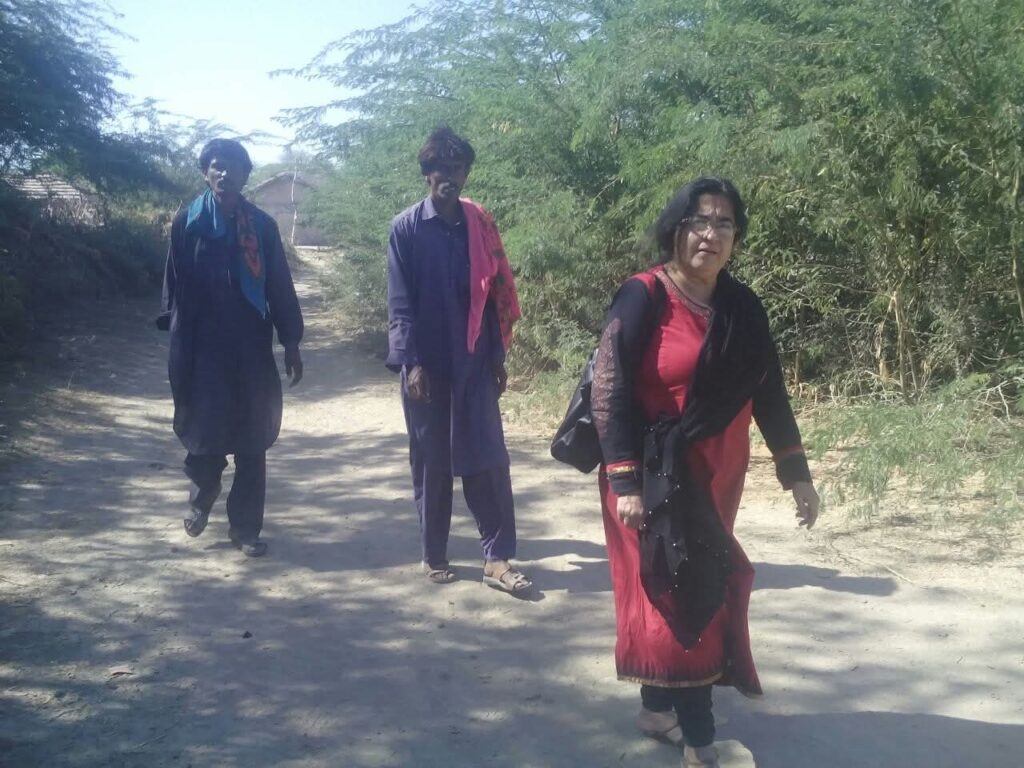
The desert journeys were the hardest and the most honest. Villages in Kutch are often scattered and hidden behind dunes, and what we see online is only a small part of the region. Many settlements lie deep inside the landscape, reachable only by walking.
I have an old photograph the weaver clicked — me standing in the middle of the white desert. I told him it wasn’t necessary. He smiled and said, “Didi, yaad rakhoge kitni mehnat ki registan mein.”
He was right. The karigars who walked with us for more than a kilometre did so out of sheer courtesy. No expectation. No complaint. Just companionship.
And that touched me.
Their simplicity reminded me how much effort goes into every woven piece — not just in the loom work, but in the physical reality of where they live, how they walk, how they carry their traditions in silence.
These Kutch travel reflections remind me how deeply simplicity shapes everyday life in the desert.
Women, Work and Respect
Every village I visited allowed me inside to meet the women and see their work — but always with men standing at the doors. It wasn’t hostility. It was guardianship. A boundary shaped by culture, not fear.
Women here work quietly in groups — weaving borders, embroidering motifs, sorting threads, preparing the loom. Their rhythm is uninterrupted, and their sense of ownership over their craft is unmistakable. There is dignity in the way they sit together, in the silence they share, and in the small smiles they give when you admire their skill.
But there is also a line that no visitor may cross.
They never allow photographs of the women at work. And this boundary has a painful history behind it.
Years ago, a handloom enthusiast from abroad managed to take a picture of a young embroidery girl. The image floated online — shared, reshared, reposted. When it eventually reached Kutch, the village was furious. Her marriage prospects were affected because her face was displayed publicly without permission. A single innocent moment became a lifelong consequence.
For us, a photo is just a memory.
For them, it can change everything.
Since then, privacy has become a matter of protection and pride. No cameras. No sneaking pictures. No exceptions.
It is heartbreaking, but it is also their reality — and the least a visitor can do is respect the boundary. People from cities often walk in with cameras and assumptions, unknowingly causing harm simply because they do not understand the cultural fabric or the weight a photograph can carry in a traditional community.
The villages closer to Bhuj or the main town are more open, more aware of how the outside world works. But the interior villages — the ones deeper in the desert — hold their own set of rules. These rules are not about restriction. They are about honour. They protect the women, the family reputation, and the sanctity of their way of life.
And once you understand this, you see the beauty in it — the way they preserve dignity in a world that often forgets what dignity means.
Finding Humour in Simplicity
There were lighter moments too — like the auto driver who told me proudly that demonetisation had improved his life because “sahukaar abh bhaada chup chap de deta hai.”
His laughter was infectious.
And for a moment I felt how uncomplicated happiness can be when life is simple & expectations are few.
A Phone Call I Won’t Forget
And then there was the phone call during the pandemic — an artisan from deep inside Kutch saying, “Log toh marte rehte hain… yaha koi problem nahi.”
I remember the sting of those words.
I wasn’t angry at him; I was angry at the distance between our realities. It’s strange how the same crisis can feel like a disaster in one place and an ordinary event in another.
Some truths of Kutch are beautiful.
Some are unsettling.
Both are real.

What Kutch Finally Taught Me
Kutch stripped away so many layers for me.
Noise. Expectations. The city pace.
It reminded me of what really matters — respect, simplicity, community, and the weight of other people’s lives.
Sometimes a place teaches you without speaking.
Kutch taught me through silence, through sand, through people who don’t realise how wise they are.
I went there to see craft.
I came back seeing life differently.
If this reflection stayed with you, the comment space is open below.
Authors Note

My name is Manju Hinduja, and on this blog I document my experiences with culture, craft, travel, and the human stories behind them. Kutch holds a special place in my journey with handloom communities. This article is a reflection of what I witnessed and felt — the dignity of artisans, the rhythm of joint families, and the desert’s own gentle wisdom. Thank you for reading and for supporting the voices and traditions that continue to shape our heritage.
You can explore more reflections like this under my Reflections section.
Disclaimer
The experiences, observations, and interactions described in this article are based on my personal journey through Kutch. Cultural practices, traditions, and village norms mentioned here belong to the respective communities, and are shared with deep respect. This piece is not intended to generalise or represent all of Kutch. It simply reflects what I witnessed, felt, and learned during my travel.
Copyright & Use Note
© 2025 Manju Hinduja. This article, “Kutch : What the Desert Taught me,” is original content.
Please do not copy, reproduce, or republish without permission.
Short excerpts may be shared with proper credit and a link back to this page.


Manju , aptly summed up , how beautifully U have captured yr experience , thanks for sharing.
“KUTCH na Kaho — Silence is golden 💛💛
Stay blessed 💞🧿🤗🙏
Thank you so much. Kutch leaves you with a quiet wisdom, and I’m grateful my writing could carry a little of that feeling forward. Truly appreciate your blessings and love. 🤗💛🙏